Security is not a final checkbox before deployment
Many organizations invest heavily in CI/CD, containers, cloud infrastructure, automation, and observability - yet security is often introduced too late in the process. The reality is simple: APIs are the backbone of modern applications. They power mobile apps, fintech platforms, AI systems, cloud-native architectures, and virtually every digital service we use.
As we accelerate software delivery, we are also accelerating our attack surface. That is why modern DevSecOps is not about adding security to software. It is about embedding security into every stage of the Software Development Lifecycle (SDLC).
Secure by Design
Security must begin before the first line of code is written. Threat modeling, risk assessments, and security requirements should be part of the design phase - not retrofitted after a pentest finds critical flaws two days before launch. A threat model identifies what you are building, what could go wrong, and what controls reduce that risk. It is the cheapest place to fix problems.
Questions every team should ask during design:
- What data does this service handle? (PII, financial, PHI?)
- Who should (and should not) access each endpoint?
- What happens when an input is malformed or malicious?
- Where are the trust boundaries?
Secure Coding Practices
Developers are the first line of defense. Writing secure code means understanding common vulnerability classes - injection, broken authentication, excessive data exposure, and misconfiguration - and knowing how to avoid them in the framework and language being used.
Key practices include:
- Input validation - never trust user-supplied data. Validate type, length, range, and format server-side.
- Parameterized queries - prevent SQL/NoSQL injection by never concatenating user input into query strings.
- Output encoding - escape data before rendering it in HTML, JSON, or XML responses.
- Least privilege - every function, service, and API key should have the minimum permissions needed to do its job.
- Authentication and session management - use well-vetted libraries (OAuth 2.0, OIDC) instead of building custom auth.
Automated Security Testing
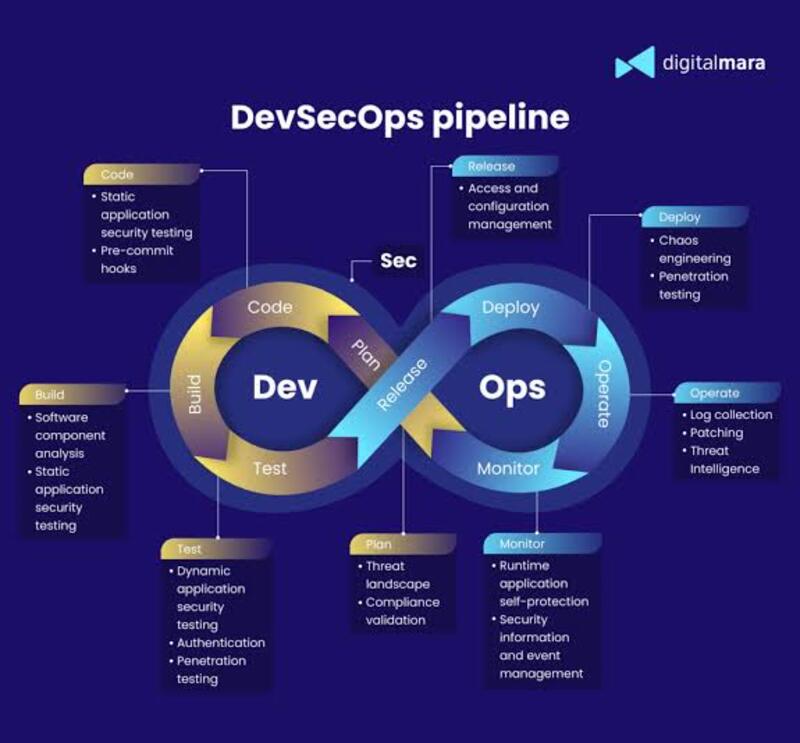
Security testing must be automated and run as part of the CI/CD pipeline, not scheduled as a quarterly event. This is the Shift Left principle - find vulnerabilities as early as possible in the development lifecycle.
- SAST (Static Analysis) - scan source code for security patterns and known vulnerabilities. Runs on every commit.
- SCA (Software Composition Analysis) - check open-source dependencies against CVE databases. Alert on critical and high-severity findings.
- DAST (Dynamic Analysis) - test running applications for runtime vulnerabilities like XSS, CSRF, and misconfigurations.
- Secret Scanning - detect hardcoded credentials, API keys, and tokens before they reach the repository.
- Fuzz Testing - send malformed or unexpected inputs to find crashes, memory leaks, and unhandled exceptions.
Continuous Monitoring
Security does not stop at deployment. Production systems need real-time visibility into what is happening. This includes:
- API monitoring - track anomalous traffic patterns, failed authentication attempts, and unusual data volumes.
- Runtime protection - tools like RASP (Runtime Application Self-Protection) can detect and block attacks in real time.
- SIEM integration - feed security events into a centralized logging and alerting platform.
- Incident response - have a playbook ready. Know who to page, what to look for, and how to roll back if needed.
Security as Code
Infrastructure, policies, and security controls should be defined in code - versioned, reviewed, and deployed through the same pipeline as application code. This makes security repeatable, auditable, and scalable.
- IaC scanning - check Terraform, CloudFormation, and Kubernetes manifests against security best practices (e.g., CIS benchmarks).
- Policy as Code - use tools like OPA (Open Policy Agent) to enforce authorization rules consistently across services.
- Compliance as Code - automate evidence collection for SOC 2, PCI-DSS, or HIPAA controls.
Security is a Culture, Not a Department
The most successful engineering teams are not the ones that deploy the fastest. They are the ones that can deploy fast while maintaining security, reliability, compliance, and customer trust.
Developers must write secure code. Operations teams must automate security controls. Security teams must empower innovation - not block it. When everyone owns security, it stops being a bottleneck and becomes a competitive advantage.
A Practical Starting Checklist
- Add SAST scanning to your CI pipeline this week
- Create a threat model for your newest service
- Remove hardcoded secrets from source code
- Set up alerts for 401/403 spikes
- Run an SCA scan on all dependencies
- Review API routes for missing authentication
FAQ
What is the difference between DevOps and DevSecOps?
DevSecOps integrates security practices into the DevOps pipeline at every stage - from design through deployment and monitoring - instead of treating security as a separate, post-development gate.
Does DevSecOps slow down development?
Not when done right. Automated security gates in CI/CD catch issues early, when they are cheapest to fix. Teams that adopt DevSecOps often ship faster because they spend less time firefighting production security incidents.
What tools should I start with?
Start with a SAST tool (Semgrep, SonarQube), SCA (Dependabot, Snyk), and secret scanning (GitGuardian, truffleHog). Add DAST and IaC scanning as your maturity grows.
How do I convince my team to adopt DevSecOps?
Start small. Pick one pipeline, add one security gate, and measure the results. Show how many issues were caught before they reached production. Data speaks louder than slides.